
Comprehensive diagnosis and technical assistance
Repairing an armour layer made of artificial concrete blocks necessarily begins with an essential first step: identifying the causes of the damage, establishing the as-built condition, and analyzing the risks to the structure. Only once this initial phase has been completed can repair works be properly designed and implemented.
CLAS experts carry out a precise diagnosis of the structural condition of the armour layer, including:
analysis of the actual causes of degradation (wave action, installation defects, scour, insufficient placement density),
mapping of risk-prone areas,
recommendations for repair or reconstruction adapted to the block type,
and technical follow-up of the works through to final validation.
Where sea conditions or the original geometry of the structure have evolved, CLAS works in coordination with the structure’s designer appointed by the owner, in order to ensure consistency between the design prescriptions and the reality of site conditions.
Two repair approaches
Repairs with dismantling: complete restoration of structural stability in severely damaged areas.
Repairs without dismantling: localized correction of non-conformities or partial stabilization at lower cost.
The methods developed by CLAS ensure mechanical and visual compatibility with the existing armour layer, in order to guarantee equivalent durability and acceptance without reservations.
Systematic dismantling is not always necessary and depends on the type of artificial block concerned. More slender blocks such as CORELOC or ACCROPODE™ II tend to break more easily than more compact blocks such as first-generation ACCROPODE™. With appropriate tools, it is often possible to adjust an artificial block in place without dismantling. This was demonstrated on the Xbloc® armour layer at DAS ISLAND, where only 50% of the blocks concerned by the remedial works were removed. 50% of the repairs were carried out without dismantling, representing a substantial saving in time and cost.
I would like to reiterate that CLAS is independent of historical license vendors. ACCROPODE™ is a registered trademark owned by the ARTELIA Group, and Xbloc® is a registered trademark owned by DMC; these companies are in no way affiliated with CLAS.
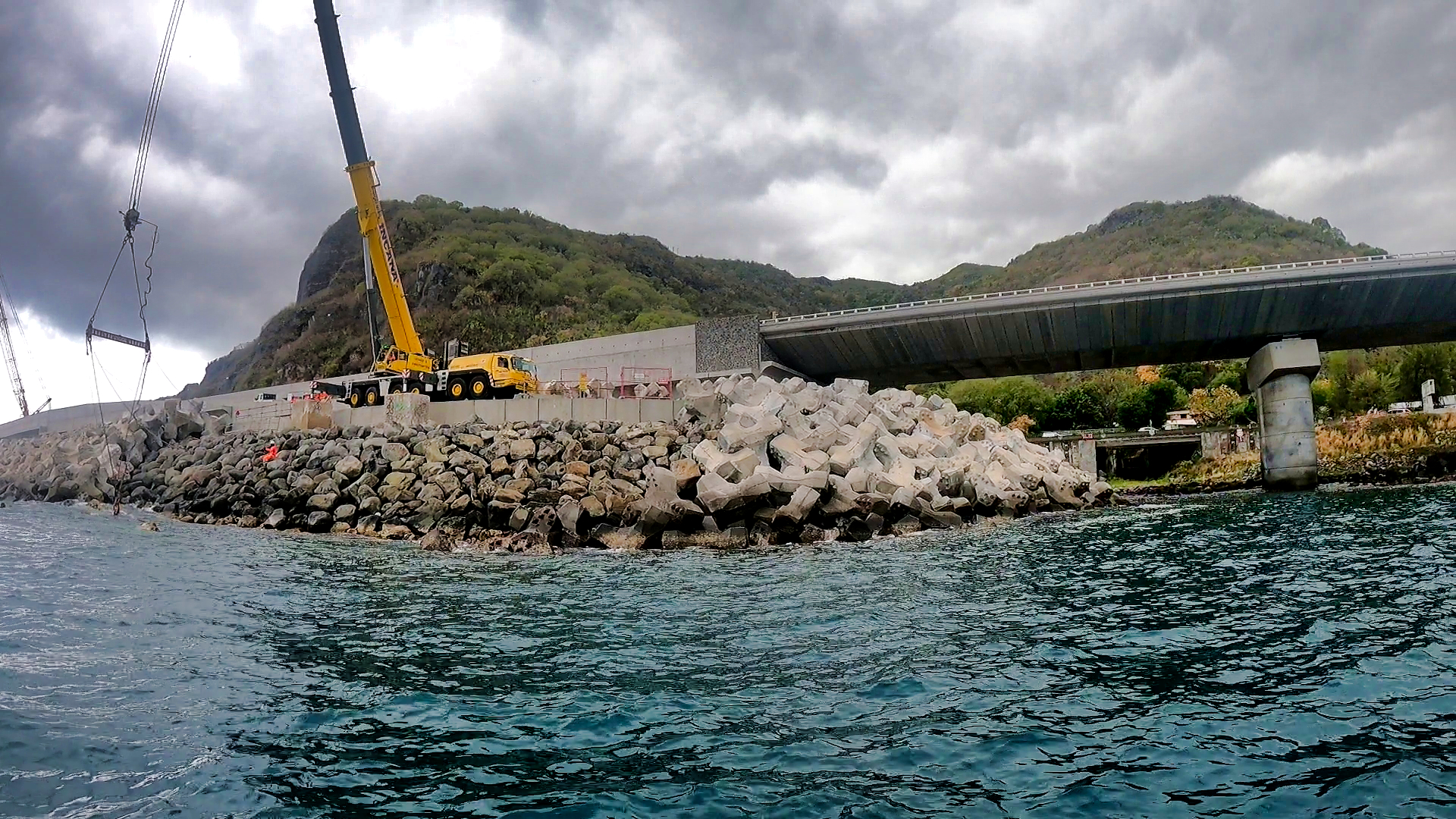
The following photograph shows the dismantling of the armour layer of one of the NRL breakwaters, made necessary by the accumulation of interlocking defects within the same area.
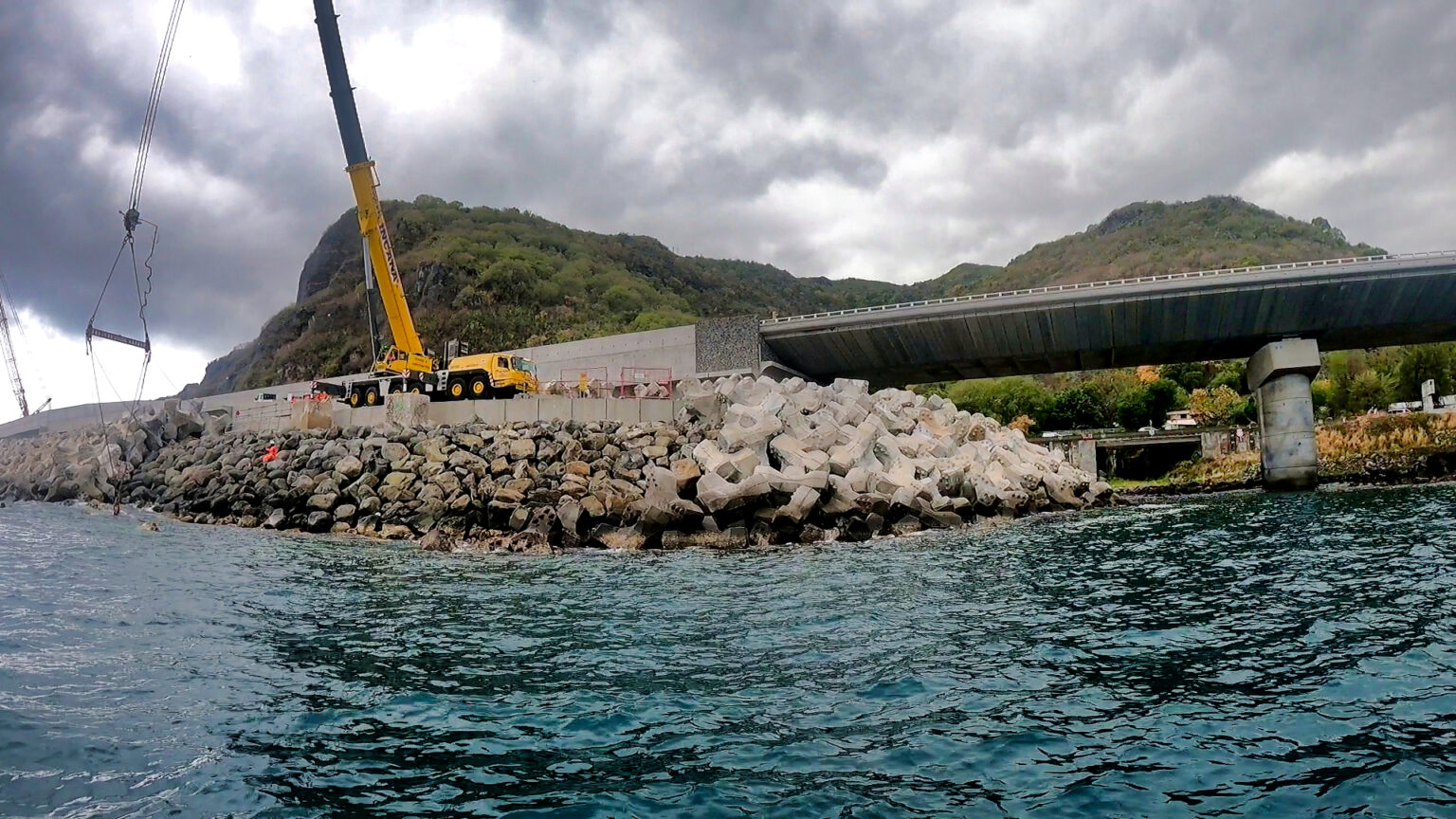
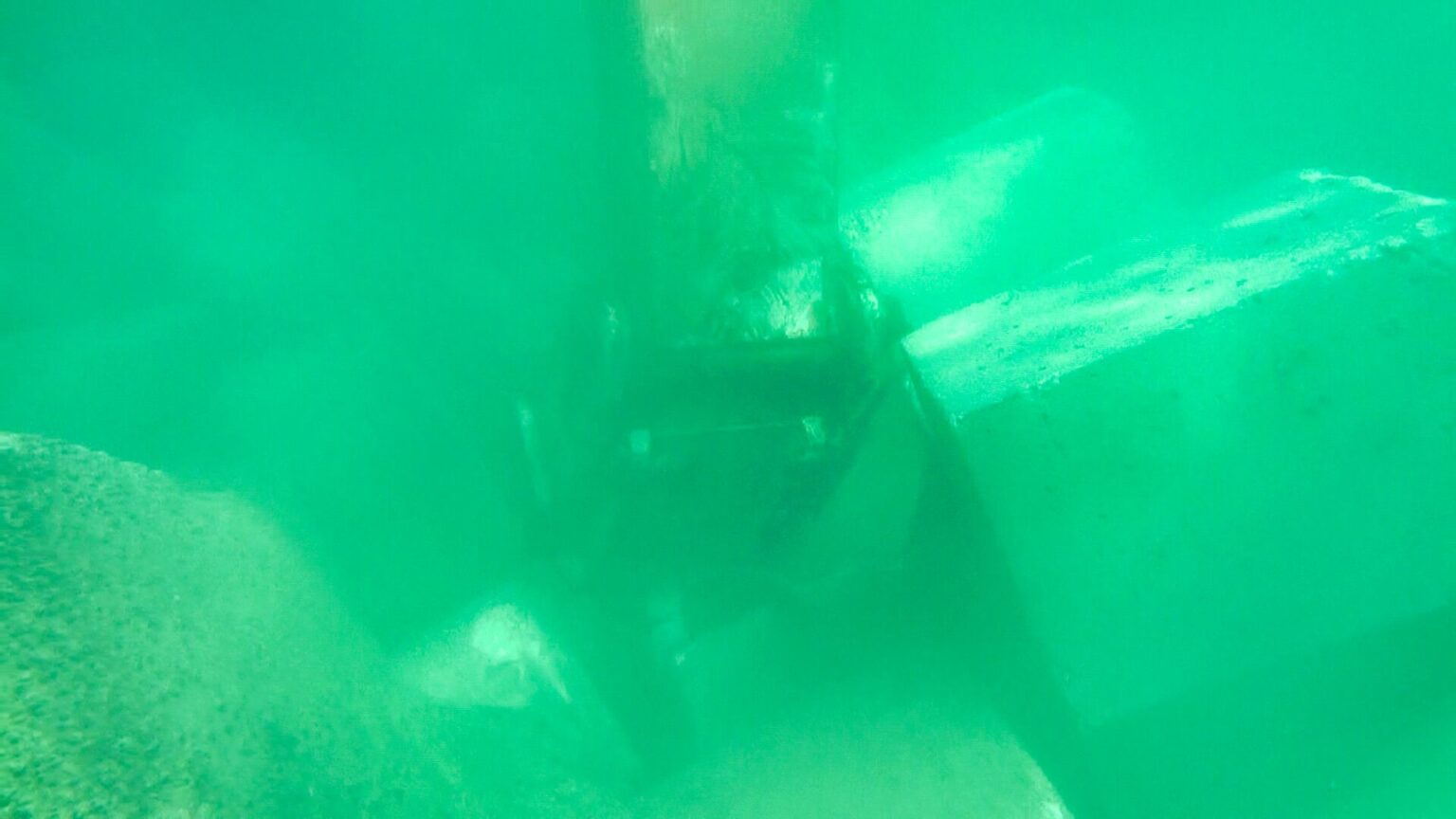
Isolated defects can be repaired without dismantling, either by pushing on the blocks using a long-reach hydraulic excavator, where available. This is the technique we successfully used on DAS ISLAND in Abu Dhabi, where CLAS experts guided the machine movements to correct interlocking defects without dismantling, whenever possible.
The following photograph is slightly blurred due to the turbidity caused by the machine movements, but it remains very informative nonetheless: the excavator bucket was removed. We trained the operator to work under diver-directed operations. As the diver was able to communicate with the operator, he guided the positioning of the excavator arm in order to apply thrust at the right location on the block.
This maneuver makes it possible to close a void, restore contact between two blocks, and sometimes even correct a block that is out of profile. However, this is only possible with certain block types and provided that the appropriate equipment is available.
For more information on these techniques, contact us.
Attempting to carry out such operations alone and without experience will lead to failure.
The use of big bags
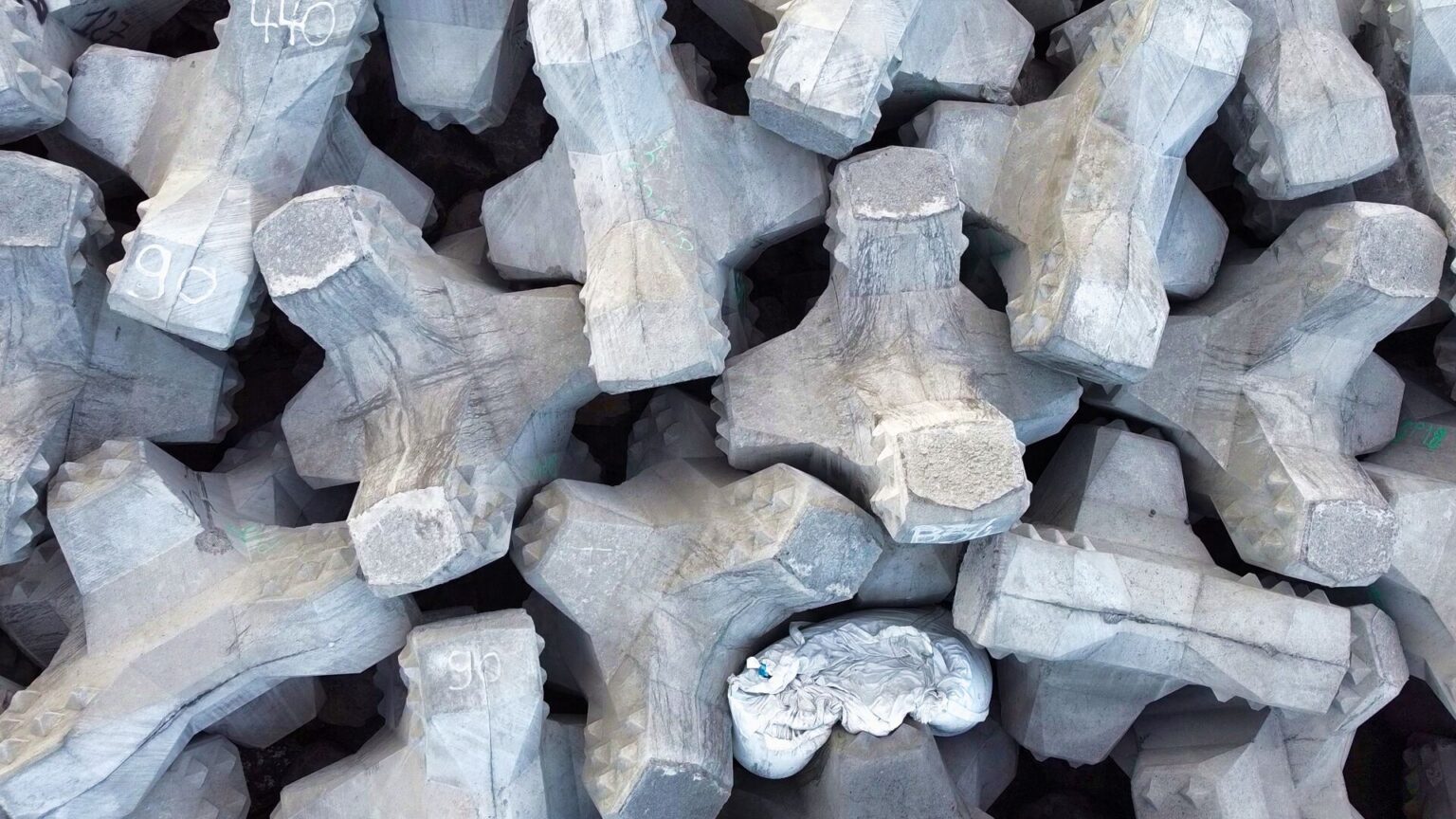
Widely used on the NRL breakwaters, this solution—intended to restrain movement, fill a cavity, and avoid dismantling—must be approached with caution.
A big bag must be able to maintain long-term mechanical restraint. Peripheral settlements must not release it; otherwise, an additional destructive factor is introduced into the armour layer. A big bag has neither the shape, nor the mechanical properties, nor the mass of the artificial concrete blocks into which it is inserted. It must therefore perfectly lock a contact defect or a void, and the surrounding area must be firmly restrained.
For these reasons, we recommend the use of big bags at the toe of the structure and at the crest, but not within the main body of the armour layer. The use of big bags within the armour layer should, in our view, be implemented as a temporary (conservative) measure, not as a permanent construction or repair principle.
The following image shows a big bag placed within a pentagonal pattern. This pentagon has no place there; it is the consequence of an installation defect—the diamond mesh pattern was not respected. It should be noted that the big bag has a volume smaller than that of the artificial blocks. It does not fill the cavity created by the pentagon; rather, it restrains the oscillatory movement of the two blocks at the base of the pentagon.
As long as the surrounding blocks remain well interlocked, this repair may hold. However, the volume of the cavity—which will receive significant water masses—raises concerns that the area may evolve. If peripheral settlements occur, the big bag, disconnected from the blocks, lighter and non-interlocking, may move under wave action. In this context, we consider it a conservative measure.
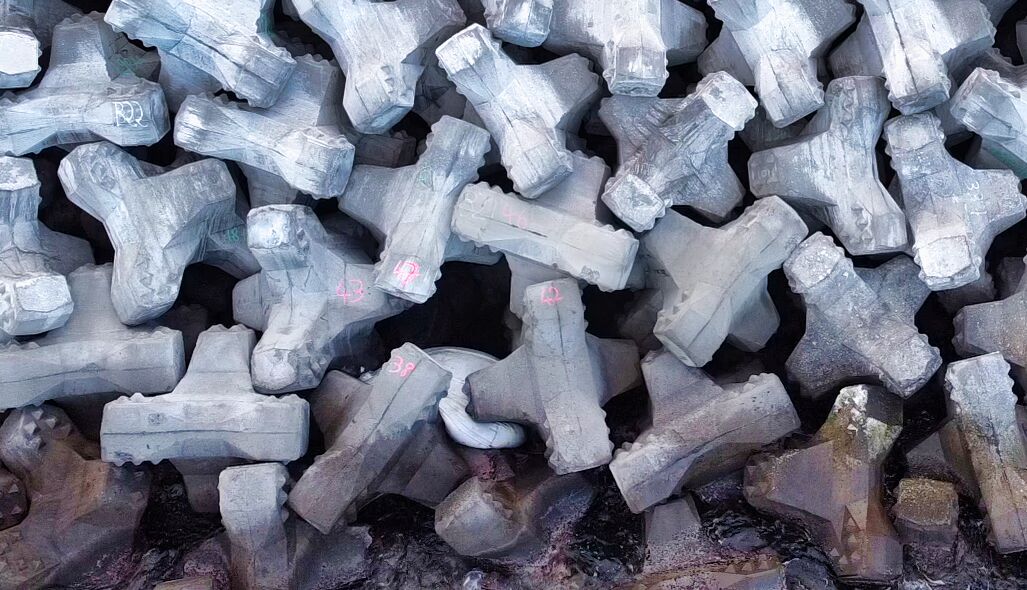
Conversely, in the following photograph we see a big bag that perfectly fills the cavity, restores mechanical contact between the blocks, and is placed within an isolated defect, with strong interlocking of the surrounding blocks.
In this configuration, the repair has every likelihood of remaining stable over time.
Contact us to carry out a risk assessment of your structure and to guide you toward appropriate strengthening, stabilization, or repair solutions for your artificial concrete block armour layer.