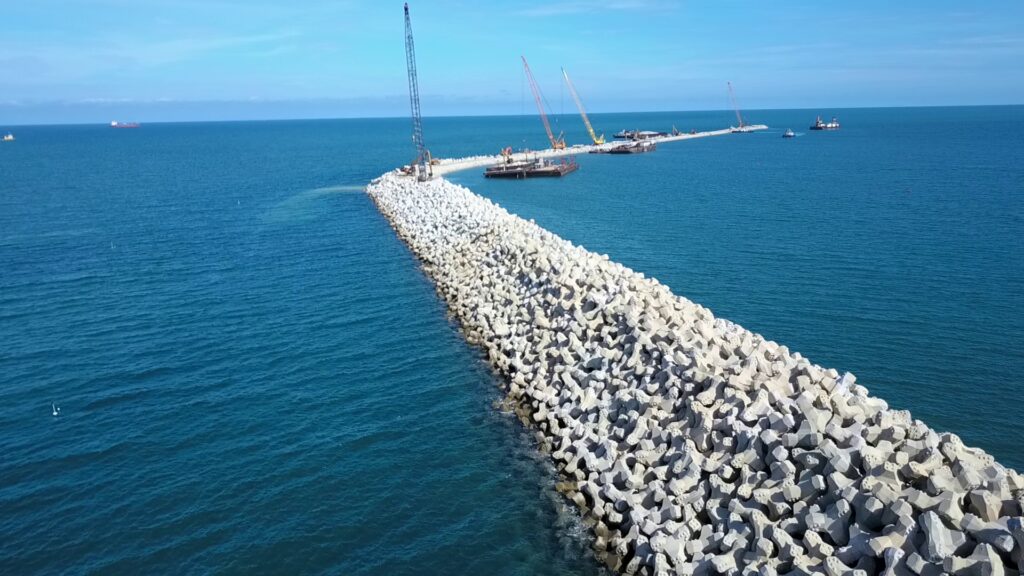
Certifying the execution quality of a breakwater built with artificial concrete armour units, from the underlayer to the crest
Since 2009, independent certification of breakwaters with artificial concrete armour units
Since 2009, CLAS has developed and applied an independent certification of the quality of maritime breakwaters built with artificial concrete armour units, based on direct observation of the structures, underwater inspection, and strict compliance with the rules of good practice.
This procedure, initially developed by IDMer and subsequently structured by CLAS, has been applied to numerous port and coastal projects, in France and internationally, on breakwaters exposed to severe wave conditions.
The objective of CLAS certification is clear: to guarantee the stability, durability and execution compliance of the structures, regardless of the type of artificial concrete armour units used and their method of deployment.
Origin of the certification of single-layer armour breakwaters
The first assignments that led to the CLAS certification originated from technical and judicial expert assessments addressing disorders observed on armour layers made of artificial concrete blocks.
These expert assessments aimed to determine the origin of the damage, analyze the underlying mechanisms, and confirm whether the remedial works complied — or did not comply — with the rules of good practice.
Progressively, the need to objectively assess the actual quality of breakwater construction execution also emerged in the industrial and port sectors. The objective was no longer limited to diagnosing disorders, but to prevent their occurrence through a structured approach to inspection and certification.
It was in this context that the CLAS certification of maritime breakwaters with artificial concrete armour layers was established.

Why certifying a maritime breakwater cannot be limited to the armour layer
The certification of the quality of a maritime protection structure cannot be reduced to a partial or purely visual inspection of the armour layer.
Experience shows that the stability of a breakwater built with artificial concrete armour units depends on a coherent system including:
the underlayer (thickness, gradation, planarity, roughness),
the armour layer made of artificial concrete blocks and its effective interlocking,
the toe berm ensuring the seating of the first row,
the crest zone and its upper locking system.
A non-conformity affecting any one of these elements may compromise the overall stability of the structure, even if the armour layer appears, at first glance, to be correctly installed.
A certificate of conformity limited to a few isolated criteria does not constitute a certification of construction quality.
Requirements of the rules of good practice for single-layer armour systems
International references for the construction of maritime breakwaters, in particular the Rock Manual and the CEREMA Rock Armour Guide, recall a fundamental principle:
single-layer armour systems with high interlocking are designed for zero damage.
Even low levels of damage are not tolerated, as they may lead to a rapid escalation of defects and a loss of stability of the armour layer.
In this context, installation quality, compliance with geometric tolerances, effective interlocking of the blocks, and immediate control of non-conformities are decisive for the long-term durability of the structure.
Analysis of non-conformities and risk classification
Any non-conformity observed on a breakwater does not automatically lead to systematic reconstruction.
It is first necessary to analyze the actual risk it poses to the structure.
Since 2009, CLAS has applied a four-level risk classification, based on construction site and expert experience:
🟢 Risk 0: isolated defect with no possible impact on stability — no action required.
🟢 Risk 1: isolated defect that may evolve without immediate serious consequence — correction or monitoring.
🟢 Risk 2: defect that may evolve rapidly with serious consequences — immediate correction.
🔴 Risk 3: grouped or connected defects leading to a serious disorder — reconstruction of the affected area.
This approach makes it possible to avoid both unnecessary dismantling operations and the underestimation of critical disorders.
Reference standards used for CLAS certification
Technical reference documents
They include the contractual documents provided within the framework of artificial concrete armour unit technologies, where such documents exist.
These documents form a working basis, but do not always suffice to guarantee the actual long-term durability of the structures, as they are often derived from laboratory testing and do not take into account the full range of situations encountered in real field conditions.
The CLAS technical reference framework
CLAS additionally applies an internal technical reference framework, built on more than thirty years of experience on projects implementing the majority of artificial concrete armour units used worldwide.
This reference framework integrates:
risk classification,
analysis of breakage mechanisms,
operational acceptance criteria,
inspection methods adapted to actual site conditions.
CLAS certification procedure: from design to final acceptance
CLAS certification covers the entire breakwater construction process:
Design and profile review
Analysis of the profiles, materials, thicknesses and water depths defined by the designer.
Placement drawings
Verification of the consistency of the placement drawings with on-site conditions, allowable tolerances and transitions between zones.
Inspections during construction
inspection of the underlayer and the berm,
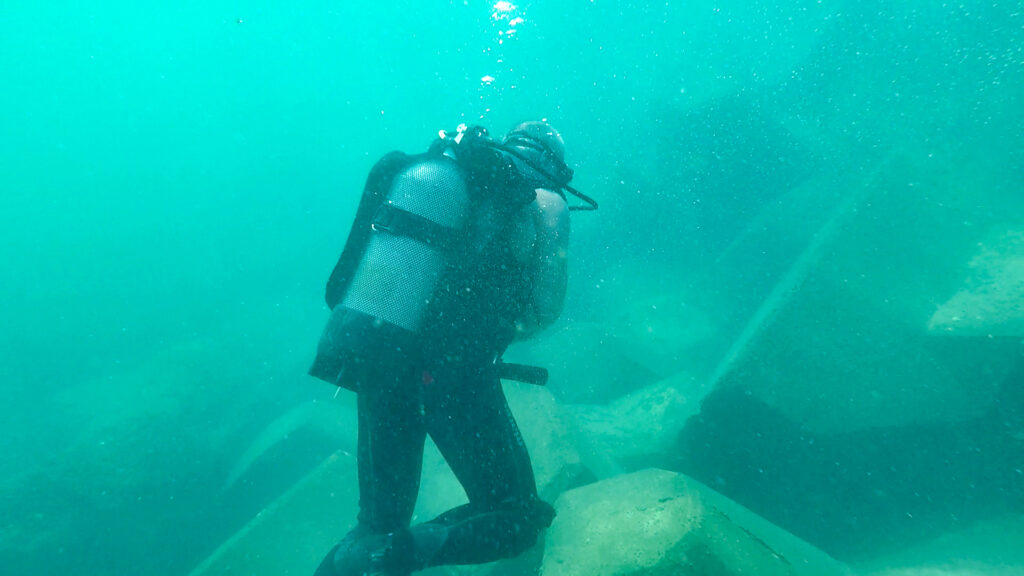
regular underwater inspections,
control of artificial concrete armour unit placement,
above-water and drone inspections.
Each phase is validated before proceeding to the next stage of the works.
Compliance report
At the end of the inspections, CLAS issues a Technology Compliance Report, documenting all inspections carried out and certifying the compliance of the structure.
Result: a CLAS-certified structure – Class A
A CLAS-certified structure – Class A – is a structure that is:
compliant with its design and the technology implemented,
built in accordance with the specified tolerances and acceptance criteria,
demonstrating verified stability and durability.
CLAS certification provides project owners and contractors with an objective technical guarantee, based on factual findings and independent expertise.
Offshore breakwater at Port-la-Nouvelle built using CLAS TECHNOLOGY COMPLIANT™ methods and procedures
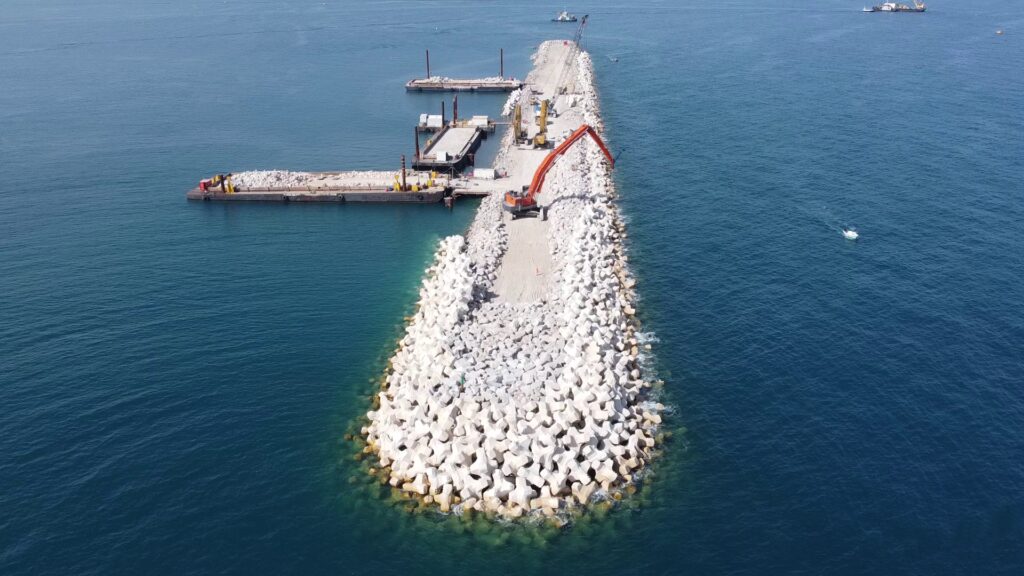
Palamós breakwater constructed without CLAS TECHNOLOGY COMPLIANT™ methods and procedures
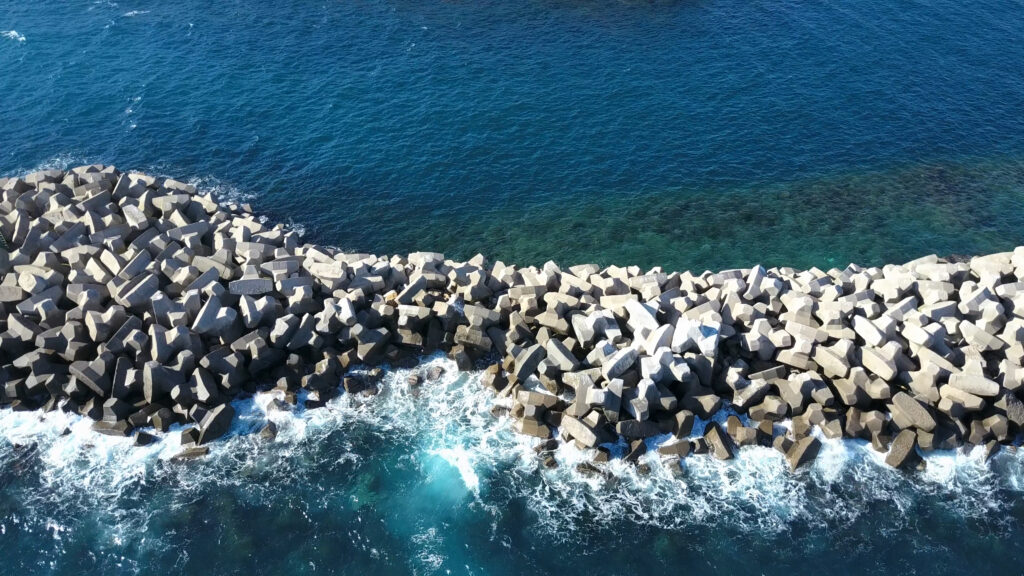
A certification recognized on major international projects
For more than fifteen years, CLAS certification has been built on a simple reality: a maritime breakwater built with artificial concrete armour units can only be considered compliant and durable if its design, installation and control strictly comply with the rules of good practice applicable to highly interlocking single-layer systems.
By relying on direct inspection of the structures, underwater presence, rigorous analysis of non-conformities and an objective risk classification, CLAS provides an independent technical guarantee, based on real on-site experience rather than theoretical or partial validations.
This global approach, from the underlayer up to the crest, enables project owners and maritime contractors to secure their projects, reduce technical and contractual risks, and guarantee the stability and durability of maritime breakwaters, regardless of the technology or type of artificial concrete armour units implemented.
Choosing CLAS certification means choosing independent, pragmatic and recognized expertise, serving execution quality and the long-term durability of coastal protection structures.
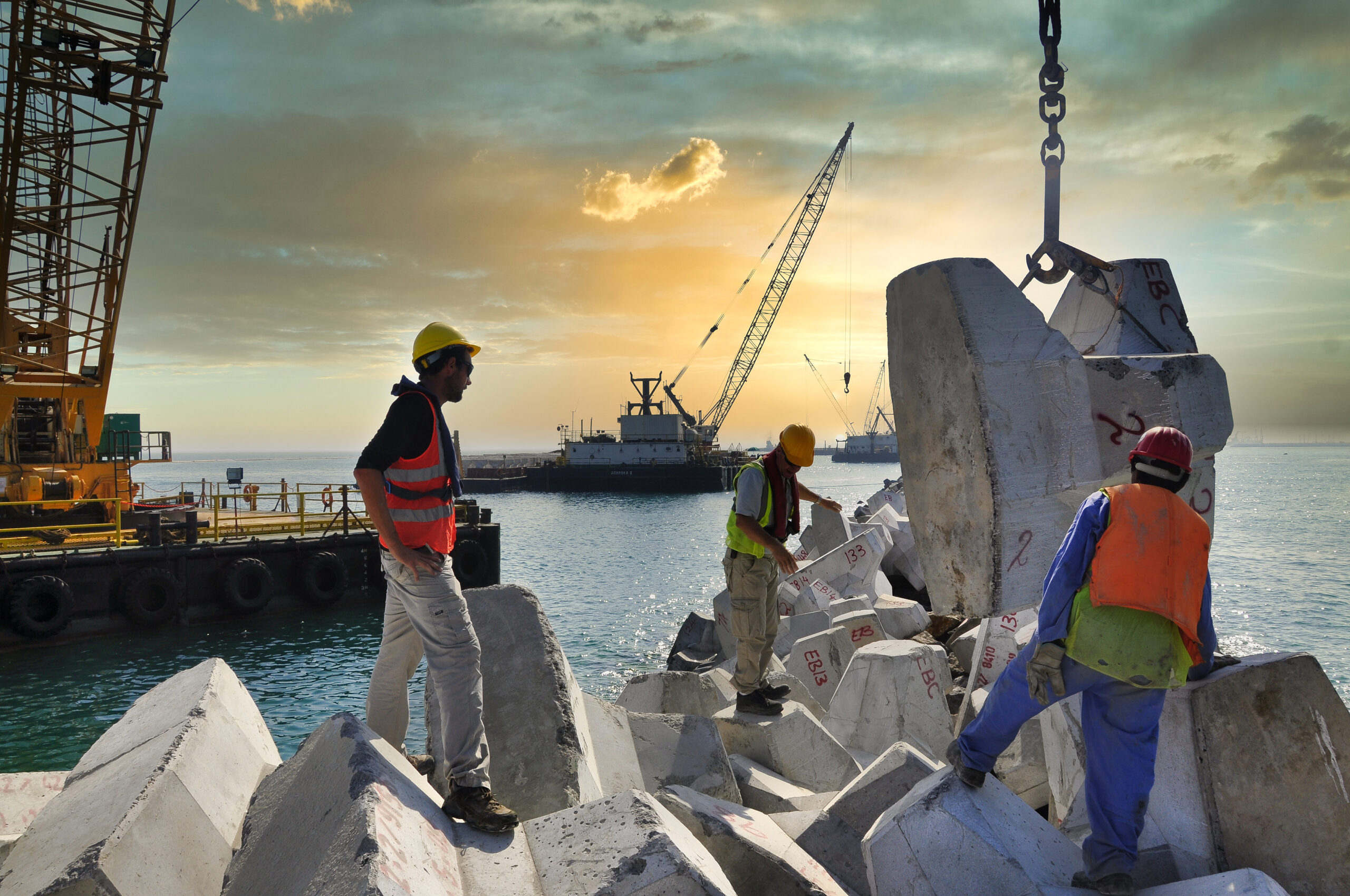
Certification of the Khalifa Port breakwaters in Abu Dhabi in 2010
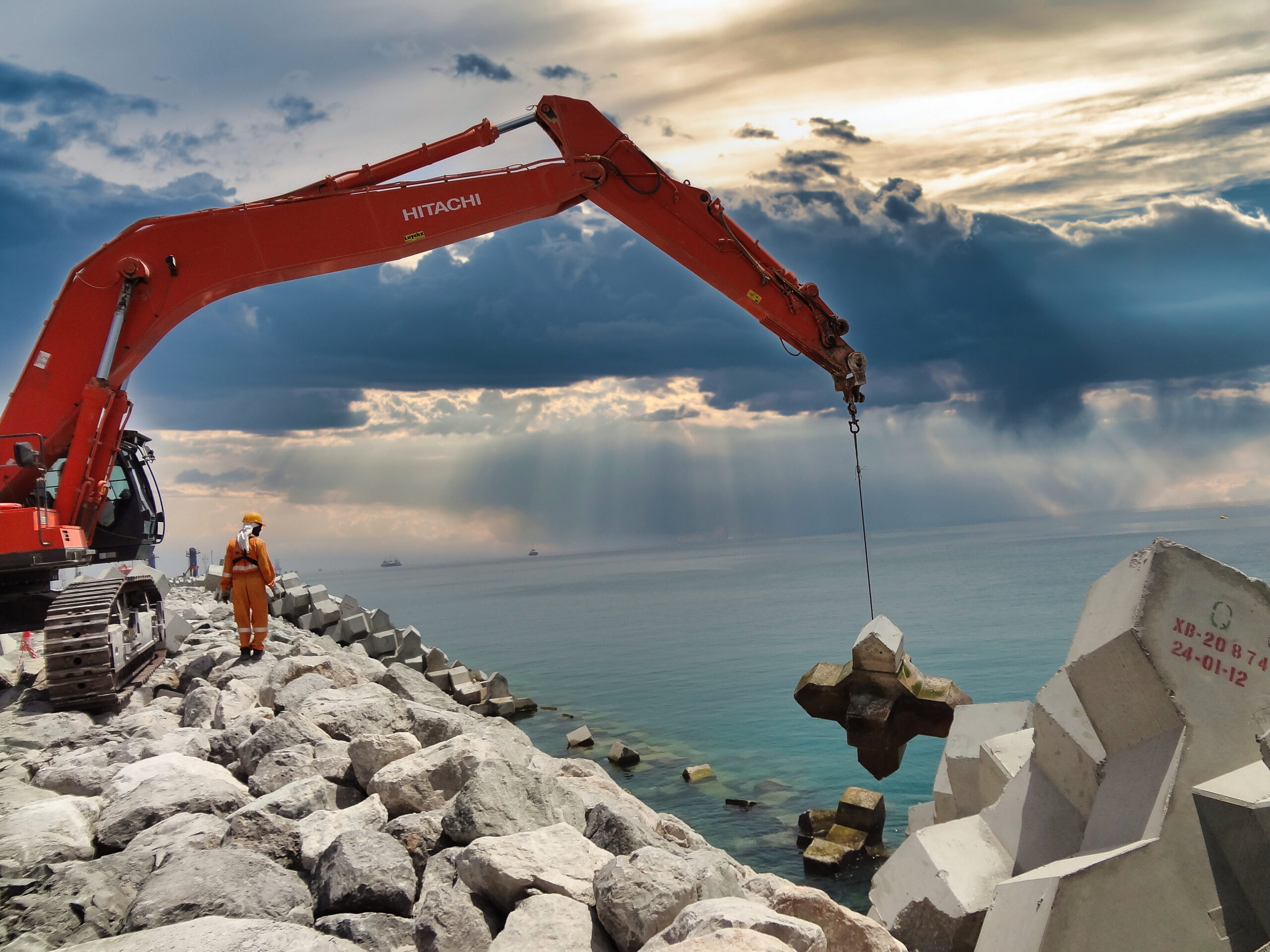
Certification of the Das Island breakwater in Abu Dhabi in 2012
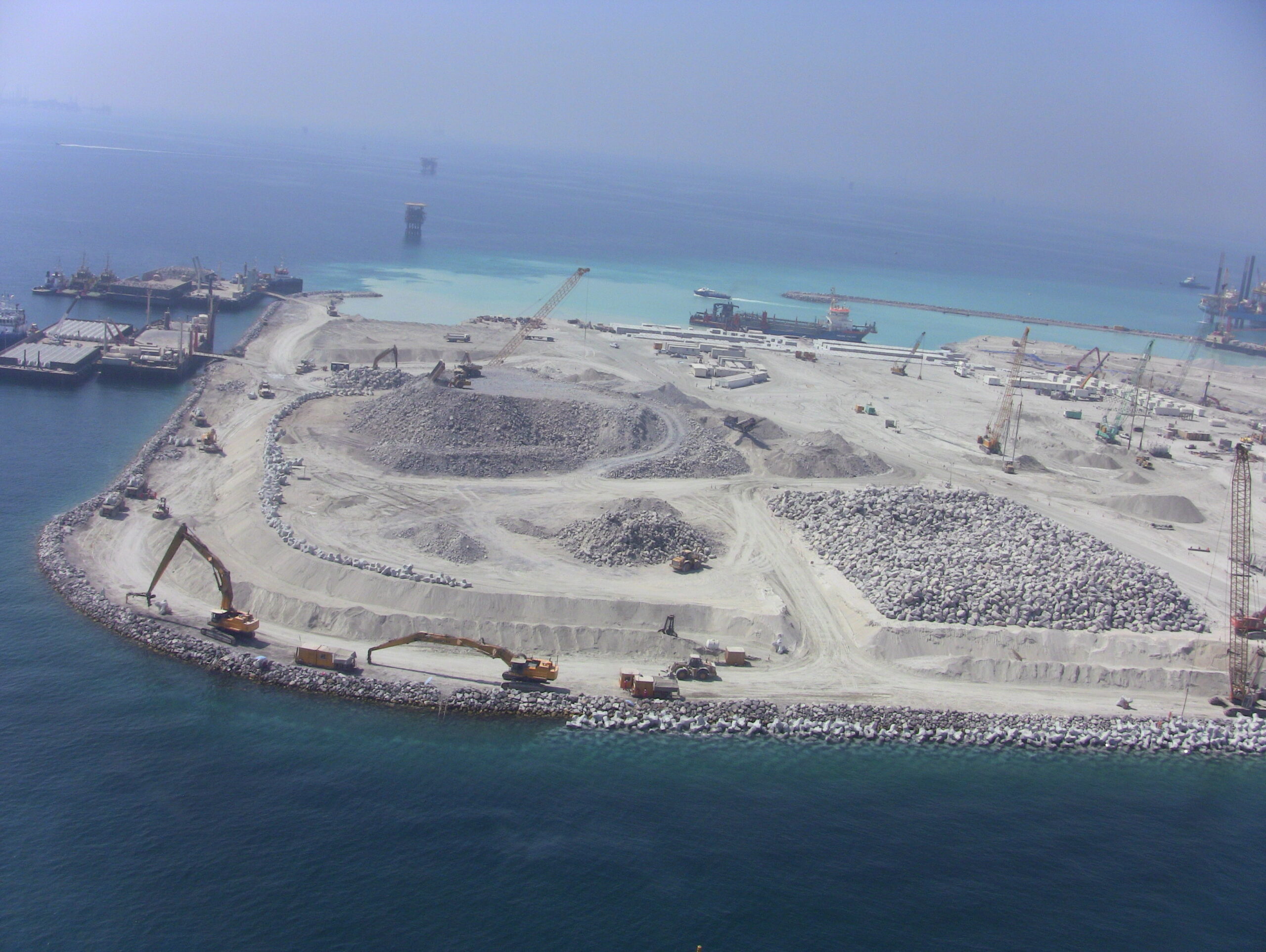
Certification of the Zakum Islands breakwaters in Abu Dhabi in 2013
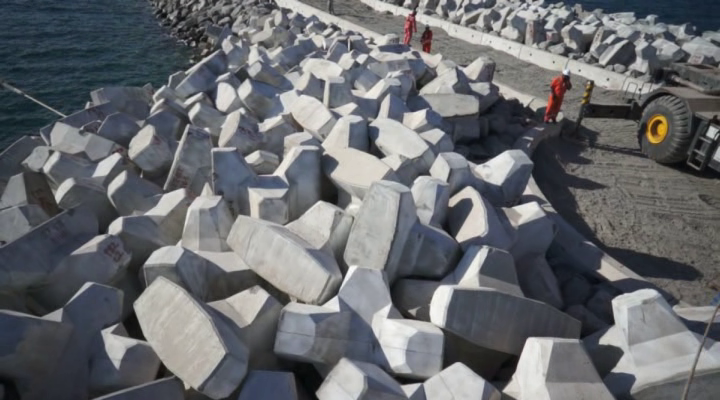
Certification of the ACCROPODE™ armour layer of Zirku Island in Abu Dhabi
A certification based on real-world experience and the rules of good practice
The certification of maritime breakwaters built with highly interlocking artificial concrete armour units cannot be reduced to a simple document review or to a one-off validation of the visible armour layer. It requires a global, continuous and independent approach, based on direct observation of the structure, a thorough understanding of stability mechanisms, and strict compliance with the rules of good practice applicable to single-layer systems.
Since 2009, CLAS has developed and applied a certification methodology based on a comprehensive analysis of the structure, from the foundation and underlayer through to the armour layer and the crest. This approach incorporates objective technical criteria, a rigorous classification of non-conformities, and the ability to intervene immediately when deviations are identified, in order to preserve the stability and long-term durability of the structure.
CLAS certification is not intended to compare technologies or to promote any particular system. Its sole objective is to guarantee that the constructed breakwater is compliant with its design, with the technology implemented, and with the durability requirements expected by the project owner, regardless of the brand or origin of the artificial concrete armour units used.
By relying on recognized field expertise, qualified inspectors, proven procedures, and total independence from trademark or license holders, CLAS provides project owners and maritime contractors with a reliable framework to secure their projects, reduce technical risks, and guarantee the final quality of maritime breakwaters.
Choosing CLAS certification means choosing a pragmatic approach, grounded in real site experience, risk control, and compliance with the rules of good practice, in the service of the long-term durability of coastal protection structures.