
ARTIFICIAL UNDERLAYER FOR BREAKWATER ARMOUR LAYERS
Why design an artificial underlayer?
The construction of a single-layer armour breakwater requires a fully controlled underlayer.
This is one of the most critical aspects of any project, as it directly governs the stability, placement accuracy, and long-term durability of the structure.
Experience shows that the construction of the placement slope is very often the main difficulty encountered by contractors.
Problems Encountered with Natural Rock Underlayers
In single-layer armour breakwaters, the underlayer is generally composed of two layers of natural rock.
These layers must comply with strict geometric tolerances.
If these tolerances are not met, the placement of artificial concrete armour units becomes difficult—or even impossible—and the overall stability of the armour layer is compromised.
During construction, it is not uncommon for significant wave action to damage or destroy the underlayer, resulting in financial losses and construction delays.
Similar situations have been observed on several projects, including cases documented in the technical documentation of certain license vendors.
The supply of compliant rock armour is also becoming an increasing challenge:
its cost, availability, and above all its environmental impact are now major concerns for project owners.
Mountain quarrying – transport nuisances – carbon footprint: all these factors are driving the need to rethink traditional solutions.
Armour unit out of profile due to a defect in the natural rock underlayer.

Presentation of the Artificial Underlayer
An Innovative and Patented Solution
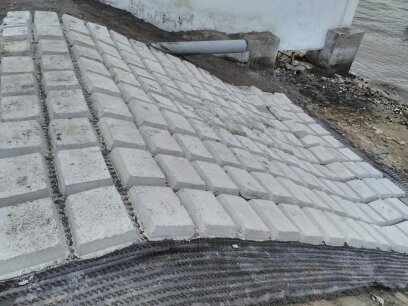
To address these challenges, CLAS has developed and patented an artificial underlayer solution, inspired by technologies already used for the protection of subsea pipelines and riverbanks.
These systems use interconnected concrete panel mats, either contiguous or spaced, providing a level of stability and regularity that cannot be achieved with natural rock.
When applied to the construction of sloped breakwaters, this technology reproduces the surface roughness required for proper interlocking of artificial concrete armour units, while fully complying with the geometric tolerances defined by the design.
Design Principle
The artificial underlayer consists of two superimposed layers:
First layer: concrete studs of uniform size, interconnected by a looped geotextile or cables.
It protects the core and forms a stable base.
Second layer: concrete studs of varying heights, reproducing the roughness of a natural underlayer.
It allows water to flow through the interstices and promotes the interlocking of the armour units.
When project constraints allow for the installation of only a single layer, this layer is designed to reproduce the roughness and planarity characteristics of a double underlayer.
Installation and Manufacturing
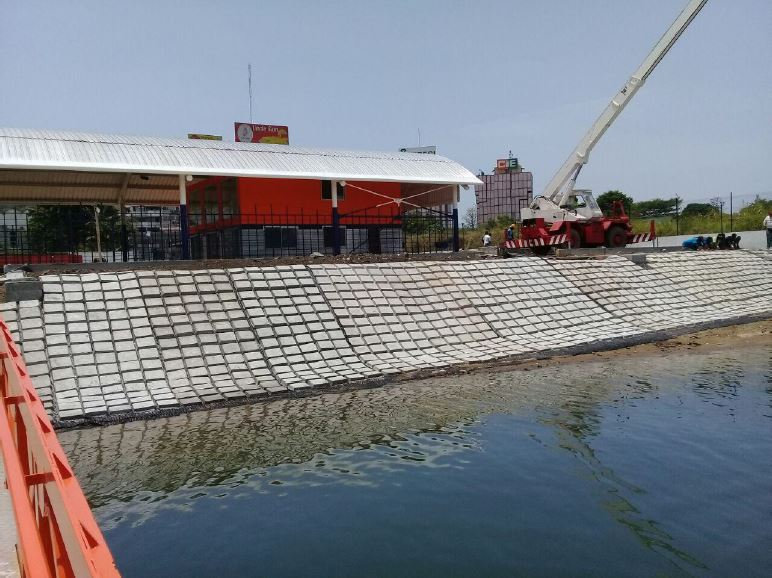
The installation of the concrete stud panels is based on proven methods used for the protection of pipelines and riverbanks.
Each panel is positioned and adjusted under the supervision of a CLAS-accredited inspector, trained in diving operations.
Beyond its environmental benefits, the artificial underlayer offers numerous advantages:
rapid protection of the core;
increased stability under wave action;
guaranteed geometric tolerances;
a significant reduction in the volume of rock armour quarried and transported.

Technical and Environmental Advantages
Precise control of planarity and surface roughness.
Reduced risk of damage by wave action during the construction phase.
Lower environmental impact: elimination of large-scale rock quarrying.
Time savings during installation and inspection phases.CLAS calculates the optimal size of the concrete studs, defines the most appropriate installation methods, and supports the contractor through to the certification of construction quality.