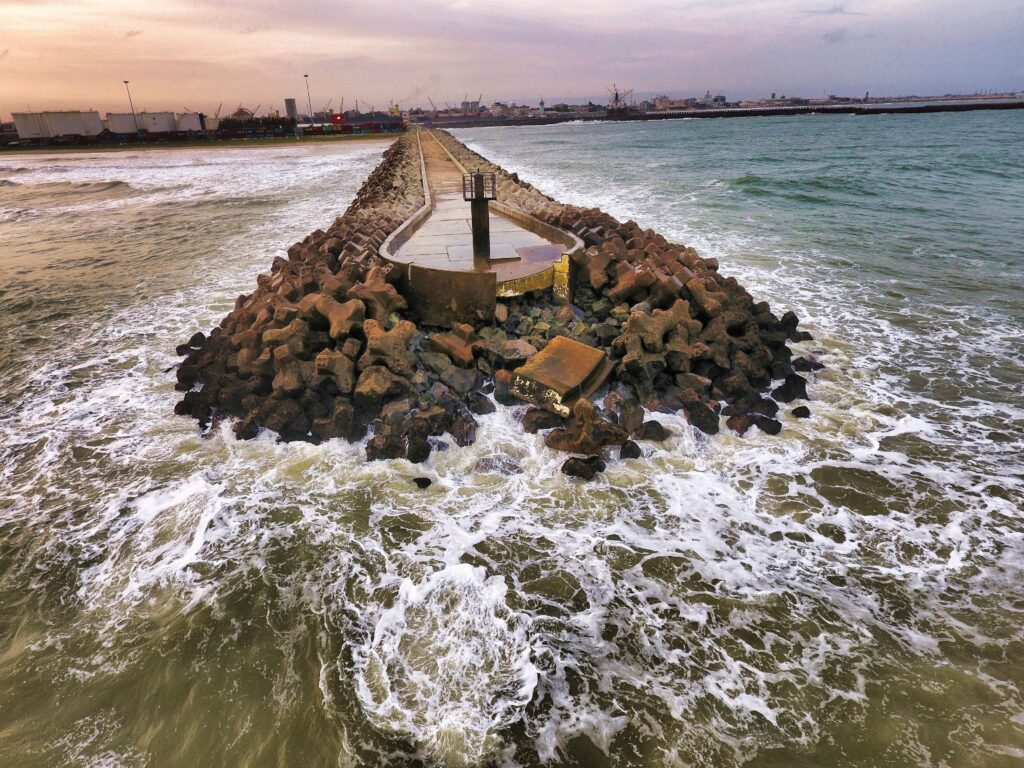
Classification of Armour Layers and Risk Levels
The Three Compliance Classes
The CLAS classification distinguishes three main classes that define the level of compliance of a structure with respect to design and good engineering practice.
Class A – Compliant and Durable Construction
All design and installation criteria are complied with.
The armour layer provides maximum hydraulic stability and zero structural risk (Risk 0).
The structure is CLAS Technology Compliant™ certified and may be accepted without reservations.
This class corresponds to structures that have benefited from full-time supervision and CLAS technical assistance.
Class B – Satisfactory Construction Requiring Monitoring
Certain tolerances are reached or exceeded, without compromising overall stability.
Structural risk level 1 to 2: the armour layer remains stable, but adjustments may be required.
Regular inspection is recommended, particularly after storms.
Class C – Non-Compliant or At-Risk Construction
Partial or total non-compliance with the design.
Interlocking defects, lack of underlayer rock, or placement errors.
Structural risk level 3: the durability and/or functionality of the structure are threatened.
The structure cannot be certified without complete remediation of defective areas.
The Four CLAS Risk Levels
The risk-level classification complements Classes A, B and C by assessing the technical and economic consequences of the observed defects.
| Risk level | Description | Consequence |
|---|---|---|
| Risk 0 | Structure compliant with the design and tolerances. | CLAS Class A certification – acceptance without reservations. |
| Risk 1 | Minor defect with no impact on stability. | No immediate corrective action required; monitoring recommended. |
| Risk 2 | Localized defect that may affect stability in the medium term. | Partial repair or adjustment under CLAS supervision. |
| Risk 3 | Major defect compromising the safety of the armour layer. | Dismantling and reconstruction required. |
Each risk level is documented in the CLAS inspection report, supported by photos and videos, GPS survey data and recommended corrective actions.
A Risk-Level Framework Recognized in Public Procurement
The risk levels used by CLAS (Risk 0 to Risk 3) are recognized and incorporated into public procurement contracts, in particular in recent maritime works CCTP specifications in France, in order to objectify quality control, stability and durability of artificial armour layers for breakwaters.
They make it possible to assess, document and address non-compliances based on clear and reproducible thresholds, with a view to acceptance without reservations.
ℹ️ The “armour layer classification” (e.g. Classes A/B/C) is an internal CLAS convention used to structure reporting and certification.
It is not intended to be presented as a market standard; it complements the risk levels required or accepted in the CCTP.
Risk 0: structure compliant with the design and tolerances → acceptance possible without reservations.
Risk 1: minor defect with no impact on stability → monitoring.
Risk 2: localized defect that may affect stability → controlled repair/adjustment.
Risk 3: major defect compromising safety → securing of the structure, and facilitation of dialogue between the Client (MOA), the Engineer (MOE) and the Contractor during dismantling/reconstruction of the area.
This risk-level approach improves traceability, transparency, and the inspection and acceptance processes.
A Management and Prevention Tool for Non-Compliance
The CLAS system is not limited to identifying deviations: it enables risks to be anticipated and failures to be prevented.
By identifying interlocking or geometric defects at an early stage, it helps avoid damage and costly repairs.
Each project monitored by CLAS benefits from:
real-time monitoring of installation quality;
full traceability of inspections;
and an up-to-date risk database, useful for future maintenance.
A Technical Reference for Project Owners
Public and private project owners are increasingly integrating the CLAS classification into their public procurement contracts and CCTP technical specifications.
This independent framework serves as a tool for transparency, evaluation and objective control, ensuring that breakwaters are constructed in accordance with good engineering practice and that they meet long-term durability and safety requirements.
This structure benefited from the support of CLAS experts This structure did not benefit from the support of CLAS experts