
Natural rock armour has gradually been replaced by double-layer concrete armour units.
Artificial concrete blocks have formed the basis of coastal protection structures for more than sixty years.
From the 1950s onwards, the first double-layer blocks appeared, in particular the Tetrapod and the BCR, relying on two superimposed layers to ensure breakwater stability. These new technologies provided greater stability than natural rock armouring and made it possible to limit the opening of quarries required for the production of very large rock units. The technical standards defining the quality of rock armouring required to ensure the durability of these highly stressed structures have continued to become more stringent, making technologies based on artificial concrete blocks increasingly attractive.
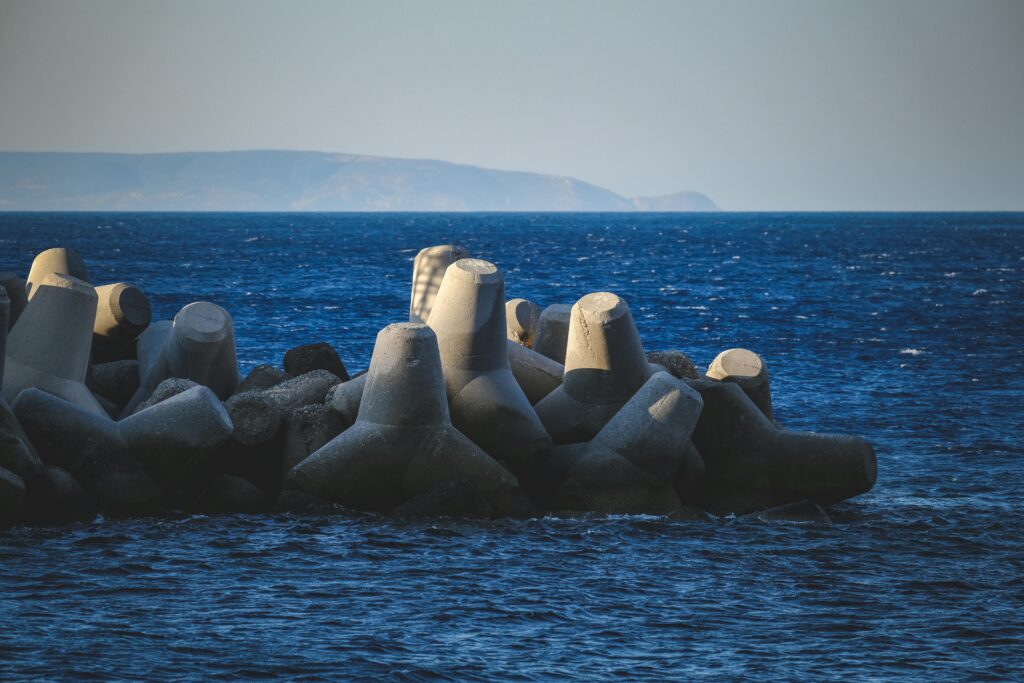
1979: The Revolution of Highly Interlocking Single-Layer Armour
A major turning point occurred in 1979 with the invention of the first single-layer block, ACCROPODE™, which reduced the volume of concrete and significantly improved the interlocking between units.
This breakthrough paved the way for several other single-layer geometries: Xbloc®, CORELOC, and various optimized variants designed to improve hydraulic stability.
ACCROPODE™ is a registered trademark owned by the ARTELIA Group, X-bloc® is a registered trademark owned by DMC; these companies are in no way affiliated with CLAS.
From 2000 onwards, the company IDMer specialized in the implementation of these artificial concrete blocks. In 2015, IDMer became CLAS, which has continued this specialization. CLAS is now a global reference in technical assistance for the installation of artificial concrete armour units and quality certification. The strength of CLAS lies in its unique and exclusive field experience and its independence with respect to historical license vendors.
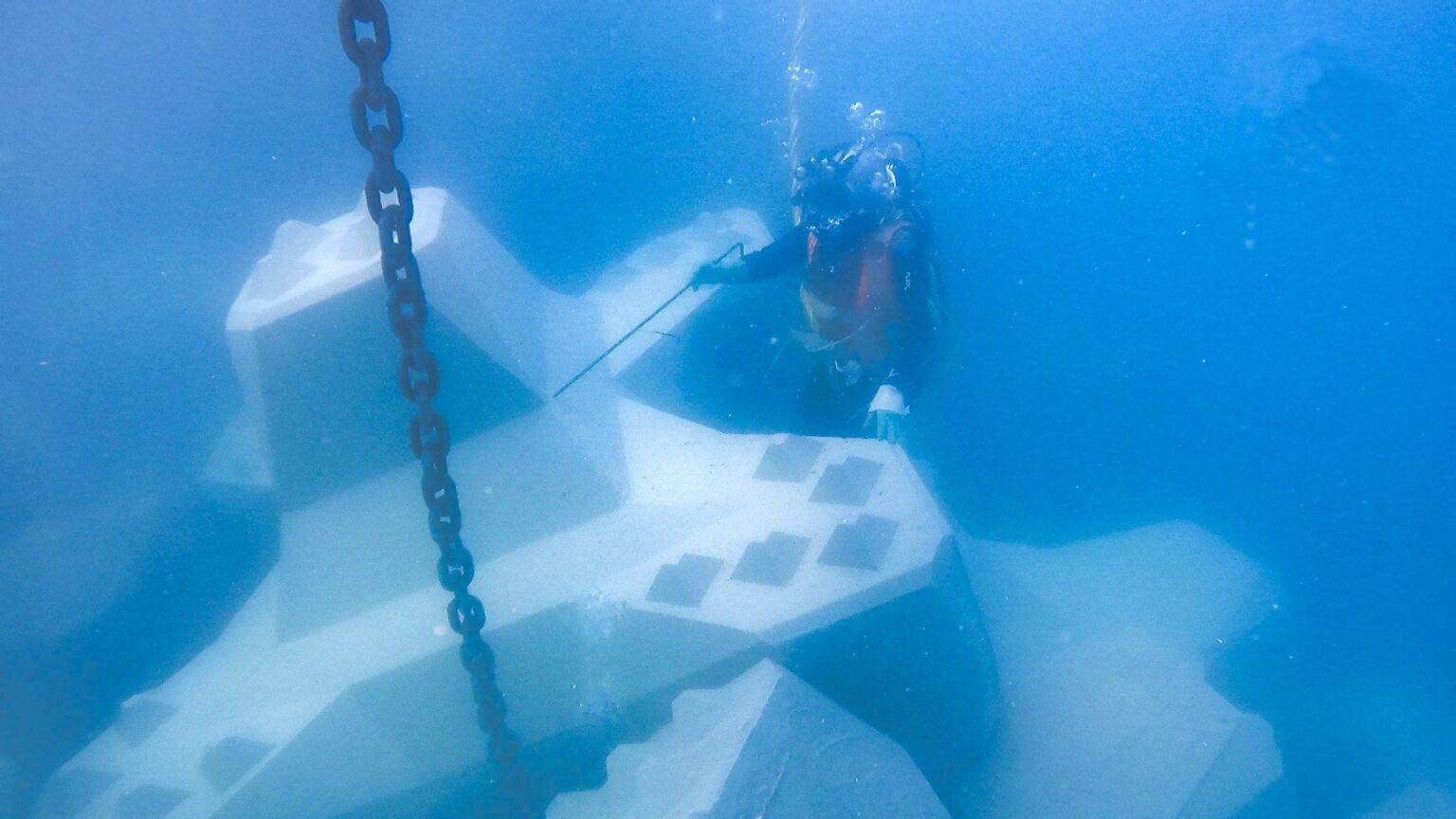
The following photo shows a CLAS expert diver installing ACCROPODE™ II units for the company Bouygues on the Port-La-Nouvelle construction site.
The ACCROPODE™ II unit entered the public domain in 2019; however, the ACCROPODE™ trademark remains the property of the ARTELIA Group, which is in no way affiliated with CLAS. CLAS operates on projects involving ARTELIA Group trademarks in a fully independent manner, providing services required under public procurement contracts or requested by contractors, which ARTELIA and its subsidiaries are unable to deliver. These services notably include diver-assisted installation and underwater placement of ACCROPODE™ units.
Why CLAS has become an essential partner for breakwater armour layer projects
CLAS has established itself as a key player in breakwater projects using artificial concrete armour units, by delivering added value that license holders do not provide.
Unlike block or license suppliers, CLAS operates in a fully independent manner and focuses exclusively on the quality of installation, operational safety, and the long-term performance of the structures.
CLAS notably provides:
- continuous on-site technical assistance throughout the construction works,
- specialized installation teams composed of divers specifically trained in the placement of artificial concrete armour units,
- safety training tailored to each project and local site conditions,
- detailed risk analyses incorporating hydraulic, geotechnical and operational constraints,
- comprehensive certification of the structure, covering all components of the breakwater: underlayer, toe protection, armour layer, toe berm and crest.
In addition, CLAS is able to respond directly to tenders requiring the use of specialized diving teams, capabilities that license holders generally do not possess.
This comprehensive, independent and field-oriented approach positions CLAS as a trusted technical partner for project owners and maritime contractors, ensuring that structures are built in accordance with best practice and meet long-term durability and safety requirements.
CLAS references and client testimonials confirm its position as a specialist in the installation of ACCROPODE™, ACCROPODE™ II, CORELOC and Xbloc® units.
Through the use of highly trained professional divers, CLAS ensures on every project a high level of safety, outstanding installation quality and long-term structural performance.
We invite you to explore our references, organized by type of units, as well as our client testimonials, which highlight the reliability, technical expertise and effectiveness of our field operations.
CLAS operates in full independence with respect to the ACCROPODE™ and ECOPODE™ trademarks, which are owned by the ARTELIA Group, and the Xbloc® trademark, which is owned by DMC. CLAS provides its services to contractors and project owners who have adopted these technologies, delivering support that the trademark licensors do not offer.
The Entry of Single-Layer Armour Units into the Public Domain
The historical patents relating to the majority of single-layer armour units are now expired.
They fall within the industrial public domain, allowing companies to offer:
equivalent armour units,
without paid licensing,
fully compliant with public procurement requirements.
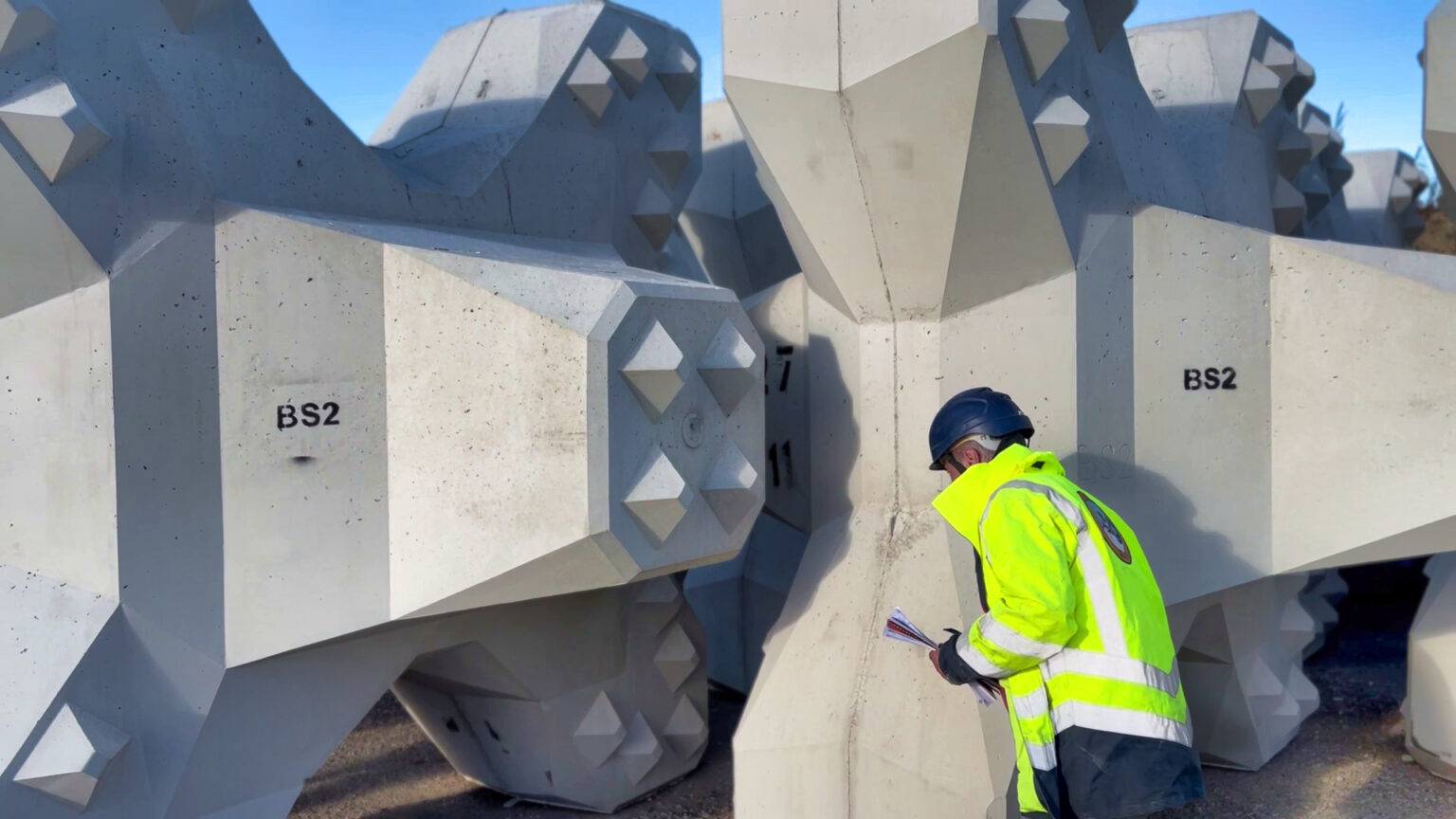
This development puts an end to situations of quasi-technical monopoly and restores broader and more cost-effective choices for contractors. The following photograph illustrates this principle.
The contractor consortium responsible for the construction of the Argelès-sur-Mer breakwater, RAZELBEC–BUESA–TDA, entrusted CLAS with full technical assistance for this project, from the preparation of placement drawings through to final certification for a Class A structure. The consortium incurred no license fees for this armour unit.
e bloc.
A European Framework Requiring Open Competition
Directive 2014/24/EU – Article 42 §4
Directive 2014/24/EU – Article 42(4) requires that any reference to a trademark, patent or model be systematically accompanied by the wording “or equivalent”.
This rule is intended to ensure:
free competition,
equal access to public procurement,
and the absence of dependency on a registered trademark.
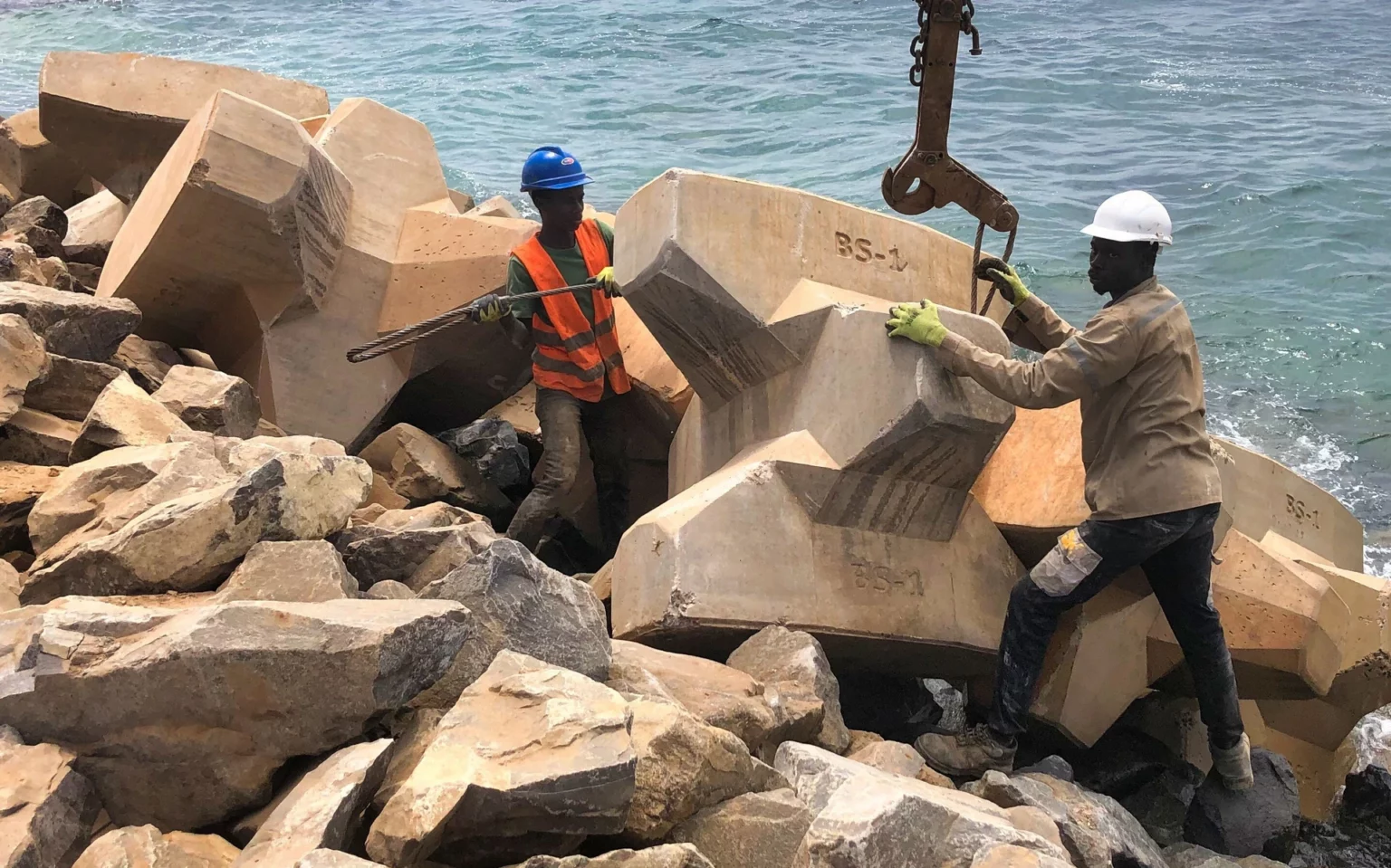
The following image shows the installation of BS1 units on the protective breakwater of the AZALAI Hotel in Dakar. No license fees were paid for this armour unit.
Transposition into French Law
In France, this obligation is reflected in:
Article R2111-7 of the French Public Procurement Code,
the guidelines issued by the Directorate of Legal Affairs (DAJ).
Public contracting authorities may therefore never impose the exclusive use of a registered armour unit without allowing the proposal of an equivalent unit. Extracts from recent CCTP documents for Port Gardian and La Chatière illustrate this legal obligation.
With regard to the increase in turbidity during the placement of rock armour and Xbloc-type concrete units (or equivalent), these units shall be washed prior to their transport to the site in order to limit any input of fines. This washing shall be carried out at the quarry, in particular for natural rock units resulting from mining and/or crushing of massive rock.
II.4.2 – Structural Concrete …………………………………………………. 66
II.4.2.1 – Structural Concrete (Wave Return Wall) ……………………….. 67
II.4.2.2 – Colloidal Concrete …………………………………………………. 67
II.4.2.3 – Concrete for Accropodes™ or Equivalent and Artificial Blocks ….. 67
II.4.3 – Constituents of Concrete and Mortars ……………………………… 68
ACCROPODE™ is a registered trademark owned by the ARTELIA Group; X-bloc® is a registered trademark owned by DMC; these companies are in no way affiliated with CLAS.
Based on its full independence, CLAS has made available to companies wishing to use these technologies that have entered the public domain the BREAKWATER SOLUTION™ trademark, in order to avoid any risk of trademark infringement.
BREAKWATER SOLUTION™: The Modern and Independent Solution
To address this new context, CLAS created BREAKWATER SOLUTION™, a brand dedicated to equivalent artificial blocks that fall within the public domain.
BREAKWATER SOLUTION™ allows companies to:
offer royalty-free blocks,
guarantee performance equivalent to registered brands,
benefit from comprehensive CLAS support: block placement drawings, installation assistance, real-time inspection, external quality control and final certification.